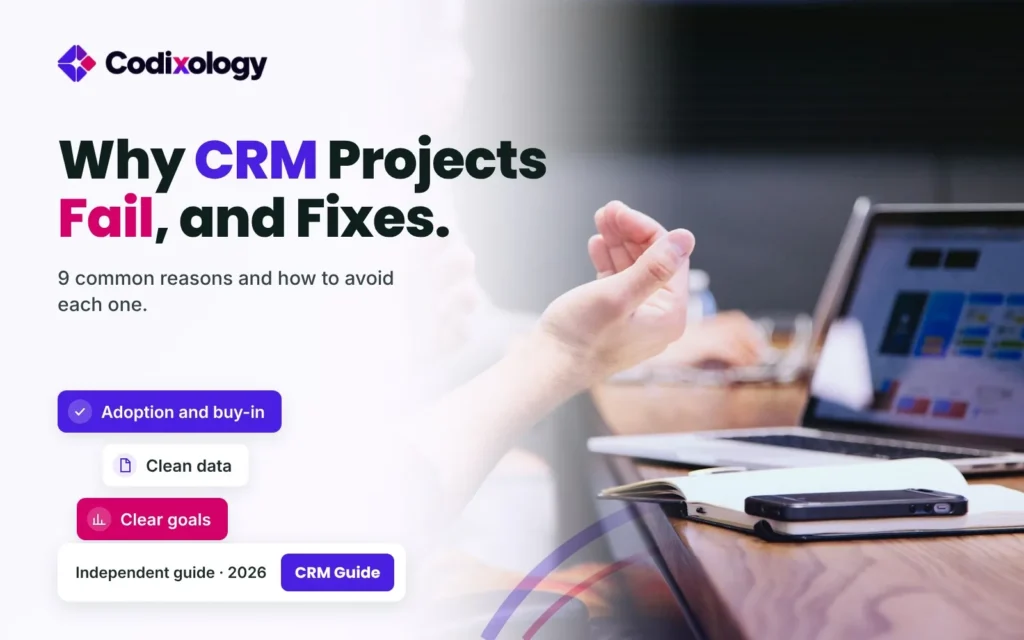
Understanding why CRM projects fail helps you avoid repeating the same predictable mistakes that derail so many implementations before they ever deliver real value. This guide covers nine common, well-documented reasons CRM projects struggle, along with practical steps to avoid each one.
Most CRM implementation mistakes aren’t unique to any specific platform, they’re process and planning failures that can happen regardless of which CRM you choose, which is why understanding why CRM projects fail matters before you begin, not after problems surface.
Why CRM Projects Fail: The Nine Most Common Reasons
Rather than a single cause, CRM projects typically fail due to a combination of planning, communication, and execution issues. Recognizing these patterns early gives you the best chance of avoiding them in your own implementation.
1. No Clear Business Goal Before Choosing a Platform
Selecting a CRM before defining what specific business problem it needs to solve is one of the most common CRM implementation mistakes. Without clear goals, it’s difficult to configure the system appropriately or measure whether the implementation actually succeeded.
2. Underestimating the Data Migration Effort
Many CRM projects fail partly because teams underestimate how much work is required to clean, map, and migrate existing data accurately. This often leads to a messy new system inheriting the same problems from the old one.
3. Insufficient End-User Involvement in Planning
Implementations designed entirely by leadership or IT without input from the salespeople and support staff who’ll actually use the system daily often produce a tool that doesn’t match real workflows.
4. Inadequate Training and Onboarding
A rushed or overly generic training process leaves users unsure how to use core features confidently, directly contributing to poor adoption after launch.
5. Over-Customization Before Understanding Actual Needs
Some CRM projects fail because teams over-customize the platform extensively before fully understanding their actual workflow needs, creating unnecessary complexity that becomes difficult to maintain.
6. No Executive Sponsorship or Visible Leadership Buy-In
When leadership doesn’t visibly champion and use the new CRM themselves, teams receive a clear signal that the tool isn’t actually a priority, undermining adoption efforts significantly.
7. Unrealistic Timeline and Budget Expectations
Rushing implementation to meet an arbitrary deadline, or underfunding the project relative to its actual scope, frequently leads to corners being cut in ways that cause problems later.
8. Lack of Ongoing Support After Launch
Treating go-live as the finish line rather than the beginning of an ongoing process means issues that arise after launch go unaddressed, eroding user confidence in the system.
9. Choosing a Platform That Doesn’t Match Actual Complexity Needs
Selecting an overly complex platform for a simple sales process, or an overly simple one for genuinely complex needs, creates friction that undermines the entire implementation regardless of how well everything else is executed.
Why CRM Projects Fail: Quick Reference Table
| Reason | Root Cause Category | How to Avoid It |
|---|---|---|
| No clear business goal | Planning | Define specific, measurable objectives before selecting a platform |
| Underestimated data migration | Planning and execution | Audit and clean data thoroughly before migrating |
| Insufficient end-user involvement | Communication | Include actual daily users in requirements gathering and testing |
| Inadequate training | Execution | Provide ongoing, hands-on training, not just a one-time session |
| Over-customization | Planning | Start with core functionality, customize incrementally based on real usage |
| No executive sponsorship | Leadership | Ensure visible leadership use and champion the CRM consistently |
| Unrealistic timeline and budget | Planning | Set realistic expectations based on genuine project scope |
| Lack of post-launch support | Execution | Budget ongoing support and improvement time beyond go-live |
| Mismatched platform complexity | Planning | Match platform capability to your actual sales process complexity |
A Step-by-Step Process to Avoid These CRM Implementation Mistakes
- Define specific, measurable business goals before evaluating platforms. Know exactly what problem you’re solving before choosing a solution.
- Involve actual end users from the earliest planning stages. Their input on real workflow needs prevents a mismatch between the tool and daily reality.
- Budget realistic time and resources for data migration and cleanup. This step consistently takes longer than initial estimates suggest.
- Start with core functionality and customize incrementally. Avoid extensive upfront customization before understanding actual usage patterns.
- Secure visible executive sponsorship and maintain it after launch. Leadership should use the CRM consistently, not just approve its purchase.
- Plan for ongoing training and support beyond go-live. Treat launch as the beginning of an ongoing process, not the finish line.
A Practical Example: A Project Derailed by Missing Goals
Consider a business that selected a CRM platform primarily because a competitor used it successfully, without clearly defining their own specific business goals first. Six months after launch, different departments use the system inconsistently, since no one agreed on what success was actually supposed to look like.
Retroactively, the team holds a session to define clear goals, improving lead response time by a specific measurable amount, for example, and reconfigures the system around that specific objective. This example shows why CRM projects fail when goals are unclear from the start, and why revisiting and clarifying objectives, even after launch, can still meaningfully improve outcomes.
A Second Example: A Project Undermined by Leadership Behavior
Now consider a CRM implementation that involved thorough planning and solid technical execution, but where sales leadership continued relying on separate spreadsheets for their own reporting after launch. Despite good technical groundwork, adoption remained inconsistent because the team noticed leadership wasn’t genuinely using the new system.
This illustrates why a single one of the nine reasons CRM projects fail, in this case lack of visible executive sponsorship, can undermine an otherwise well-executed implementation.
These two examples show that avoiding CRM implementation mistakes requires attention across multiple dimensions simultaneously, planning, technical execution, and leadership behavior, since a failure in any one area can significantly undermine the others.
How to Diagnose Which of These Reasons Applies to Your Project
If your CRM implementation is already showing signs of trouble, diagnosing which specific reason, or combination of reasons, applies to your situation is more useful than assuming it’s a single obvious cause. A brief internal review, surveying end users, checking whether goals were ever clearly documented, and assessing how visibly leadership uses the system, often reveals the actual root cause fairly quickly.
This diagnostic step matters because why CRM projects fail is rarely a single isolated event. Many struggling implementations suffer from more than one of these nine issues simultaneously, since problems in one area, like insufficient end-user involvement, often compound with related issues, like inadequate training, to create a larger overall adoption problem. Addressing the most significant contributing factor first, rather than trying to fix everything simultaneously, tends to produce more visible, motivating progress for a team already frustrated with a struggling system.
Common Weaknesses to Watch For Throughout Implementation
- Treating the implementation as purely a technical IT project. CRM success depends heavily on organizational and behavioral factors, not just correct technical configuration.
- Not revisiting goals and configuration after initial launch. Business needs evolve, and a CRM configured for launch-day requirements may need adjustment as the business changes.
- Underestimating the cultural change involved. Adopting a new CRM often requires genuine behavior change, not just learning new software mechanics.
- Skipping a pilot phase with a smaller group. Testing with a subset of users before a full rollout catches problems while they’re still easier to fix.
- Not establishing clear ownership for the CRM after launch. Someone should be responsible for ongoing configuration, training, and data quality beyond the initial project team.
Common Mistakes When Trying to Prevent CRM Project Failure
- Choosing a platform before defining clear business goals. This sequencing error undermines the ability to configure the system appropriately from the start.
- Skipping end-user involvement to save time during planning. This often costs more time later when adoption problems surface after launch.
- Underestimating data migration and cleanup effort. This is one of the most consistently underestimated aspects of CRM implementation.
- Assuming a one-time training session is sufficient. Ongoing, periodic training addresses skill gaps that emerge over time as usage patterns evolve.
- Allowing leadership to opt out of using the new system. This single behavior undermines nearly every other implementation effort, regardless of how well everything else was executed.
Expert Perspective
Organizational change management and technology implementation research consistently identifies leadership behavior and end-user involvement as stronger predictors of implementation success than the specific technical platform chosen. This supports the pattern observed across why CRM projects fail: the underlying causes are more often organizational and process-related than purely technical.
For businesses undertaking a significant CRM implementation involving substantial budget or organizational change, involving a qualified project management resource, whether internal or external, is a reasonable step to help navigate the coordination challenges across departments that these projects typically involve.
Practical Tips to Avoid CRM Project Failure
- Define specific, measurable business goals before selecting or configuring a platform.
- Involve actual end users throughout planning, not just at the training stage.
- Budget realistic time for data migration and cleanup, since this consistently takes longer than expected.
- Secure and maintain visible executive sponsorship throughout the project and beyond launch.
- Plan for ongoing support, training, and configuration adjustments after go-live, not just at launch.
Related Reading From Codixology
For a deeper look at fixing adoption problems specifically after launch, Codixology’s why your team isn’t using the CRM guide covers common root causes and practical fixes.
For a broader framework on selecting the right CRM platform from the start, Codixology’s how to choose a CRM guide covers the full decision process.
Frequently Asked Questions
What are the most common reasons CRM projects fail? +
The most common reasons include unclear business goals before platform selection, underestimated data migration effort, insufficient end-user involvement, inadequate training, and lack of visible executive sponsorship.
Are CRM implementation mistakes specific to certain platforms? +
No, most of these mistakes are process and planning failures that can happen regardless of which specific CRM platform is chosen.
How do I know if my CRM implementation is at risk of failing? +
Warning signs include unclear or undefined success goals, minimal end-user involvement in planning, an unrealistic timeline, and leadership that hasn’t visibly committed to using the new system.
Can a failing CRM implementation be turned around after launch? +
Often, yes. Revisiting unclear goals, improving training, securing stronger leadership engagement, and addressing specific adoption friction points can meaningfully improve outcomes even after a rocky launch.
How important is leadership involvement in CRM project success? +
Very important. Visible executive sponsorship and consistent leadership use of the system are among the strongest predictors of successful adoption across an organization.
Should end users be involved in choosing the CRM platform, not just using it afterward? +
Yes, involving actual daily users early in planning and platform selection helps ensure the chosen tool matches real workflow needs, reducing the risk of adoption problems later.
How long should a CRM implementation take to avoid rushing key steps? +
This varies by organization size and complexity, but allowing realistic time for data migration, testing, and training, rather than rushing to meet an arbitrary deadline, reduces the risk of the common mistakes covered in this guide.
Is over-customization really a common reason CRM projects fail? +
Yes. Extensive upfront customization before fully understanding actual workflow needs often creates unnecessary complexity that becomes difficult to maintain and can slow down rather than improve daily use.
The Bottom Line
CRM projects fail for a consistent, well-documented set of reasons: unclear goals, underestimated migration effort, insufficient end-user involvement, inadequate training, and lack of visible leadership commitment. Understanding these common CRM implementation mistakes before you begin gives you a genuine opportunity to avoid them in your own project.
Codixology recommends defining clear, measurable goals before selecting a platform, involving actual end users throughout planning, and securing visible executive sponsorship that continues well beyond the initial launch.
Ready to set your CRM implementation up for success from the start? Explore Codixology’s full CRM comparison library to choose the right platform for your actual needs.