Choosing between a free vs paid CRM is one of the first real decisions you’ll face once you’ve decided your business needs one. Free plans are tempting, no cost, no commitment, but they also come with real limitations that can quietly hold a growing business back. This guide breaks down exactly what you get (and don’t get) with free CRMs, when it makes sense to upgrade, and how to make the call without overspending or under-investing.
Free vs Paid CRM: The Right Choice
A free CRM is a great starting point for solo founders, very small teams, or anyone testing whether a CRM fits their workflow before committing money. A paid CRM becomes worth it once your team, contact volume, or need for automation and reporting outgrows what free tiers realistically offer.
The right choice isn’t about which is “better” in the abstract, it’s about matching the tool to where your business actually is right now.
What a Free CRM Typically Includes
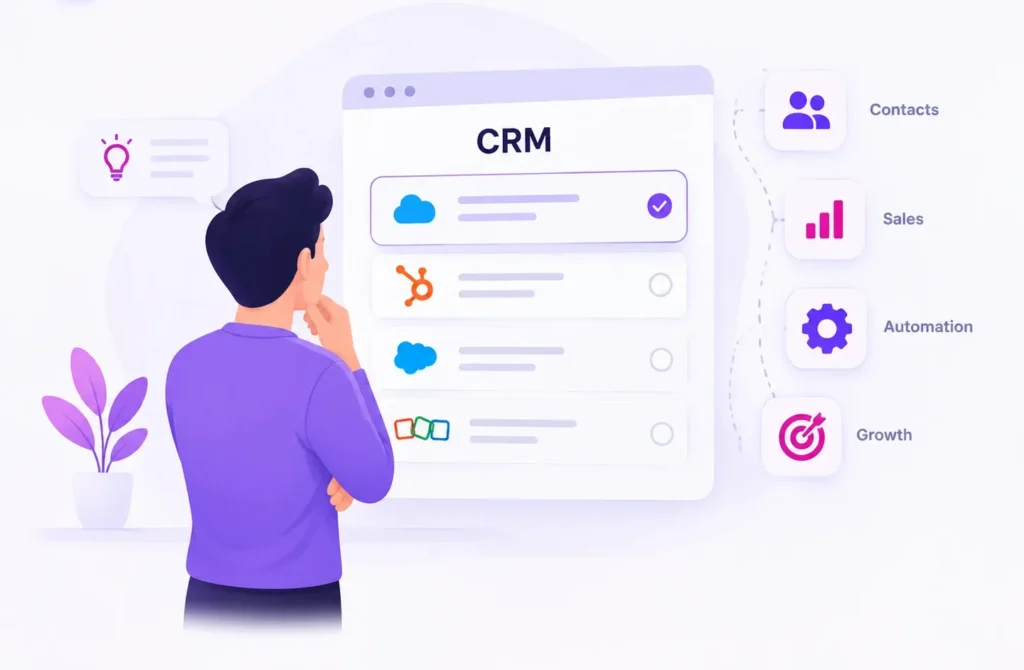
Most reputable free CRM plans (HubSpot’s free tier is a well-known example) offer a genuinely usable core:
- Contact and company records
- A basic sales pipeline
- Email logging or integration
- Task reminders
- A limited number of users (often 1-2, sometimes more)
- Basic reporting
This is enough for many small operations to run a real sales process without paying anything. It’s not a stripped-down demo, it’s a functional tool with real limits.
Free CRM Limitations You Should Know Before You Rely on One
This is where most “free vs paid” comparisons stay too vague. Here are the specific limitations that tend to matter most:
| Limitations | Why Does It Matter? |
| Contact or record caps | Some free plans cap total contacts, forcing an upgrade once you hit growth |
| Limited users | Free tiers often support only 1-5 users; adding teammates may require a paid plan |
| Basic automation only (or none) | Follow-up reminders may exist, but multi-step automated workflows usually don’t |
| Limited reporting | You may see basic pipeline stats but not deeper conversion or team-performance reports |
| Branding on emails | Some free plans add the CRM’s branding to outbound emails |
| Restricted integrations | Free tiers sometimes limit which other tools (email marketing, accounting) you can connect |
| Support level | Free users typically get community or email support only, not priority or phone support |
None of these make a free CRM “bad.” They simply define its ceiling. The question is whether your business is under that ceiling or bumping against it.
When Free Is the Right Choice
Free makes sense when:
- You’re testing whether a CRM fits your workflow at all, before committing a budget.
- Your team is one to two people, within most free-tier user limits.
- Your contact volume is modest and well under any plan caps.
- You don’t yet need advanced automation or reporting, basic pipeline tracking covers your needs.
- The budget is genuinely tight, and a free, functional tool beats no system at all.
If this describes you, don’t feel pressure to upgrade prematurely. A free CRM used consistently beats a paid CRM sitting half-configured because you’re avoiding the cost of ramping up.
When to Upgrade to a Paid CRM
The signals for upgrading are usually specific and noticeable rather than vague:
- You’ve hit a contact or user cap and can’t add a new team member or import more leads.
- You’re manually doing something a paid plan would automate, like sending follow-up sequences by hand.
- You need reporting free tiers don’t offer, to understand conversion rates, team performance, or lead sources.
- You need integrations that are paywalled, connecting your CRM to email marketing, accounting, or other core tools.
- Client-facing branding matters, and free-tier watermarks or limitations feel unprofessional for your business stage.
- You need better support, because a technical issue is now costing you real business time.
If two or more of these apply, the cost of a paid plan is likely already smaller than the cost of the workaround you’re currently living with.
Free vs Paid CRM: A Side-by-Side Comparison
| Factor | Free CRM | Paid CRM |
| Cost | $0 | Typically $10-$100+ per user/month depending on tier and provider |
| Core pipeline & contacts | Yes | Yes |
| User limits | Usually 1-5 | Scales with plan, often unlimited on higher tiers |
| Automation | Basic or none | Multi-step workflows, triggers, sequences |
| Reporting | Basic | Advanced, customizable dashboards |
| Integrations | Limited | Broader, sometimes including premium connectors |
| Support | Community/Email | Often priority, sometimes phone/chat |
| Best For | Solo founders, early testing, tight budgets | Growing teams needing automation, reporting, and scale |
How Much Does Upgrading Actually Cost?
Paid CRM pricing varies significantly by provider and tier, and per-user pricing means costs scale with your team size, an important factor many people overlook when budgeting. A plan that looks affordable at $15 per user per month becomes a meaningfully different number once you’re paying for five or ten seats.
We break down real, current CRM pricing, including what each tier actually unlocks, in our CRM cost guide. It’s worth reading before you commit, since marketing pages often lead with the lowest possible price while burying what that tier excludes.
A Worked Example: Watching the Upgrade Signal Appear
Consider a small ecommerce brand run by two founders. They start on a free CRM to track wholesale inquiries and partnership leads. For the first few months, it works fine, the pipeline has maybe 15 active leads at a time, and the free tier’s two-user limit matches their team exactly.
Six months in, they hire a part-time sales coordinator, hitting the free tier’s user cap. Around the same time, they notice they’re manually copying lead data into their email marketing tool every week, something a paid tier’s native integration would automate. Separately, they realize they can’t answer “which lead source converts best” because the free tier’s reporting doesn’t break that down.
Individually, any one of these might not justify upgrading on its own. Together, three specific, nameable gaps, a hard user-limit block, a recurring manual task, and a real reporting need, make the case clear. They upgrade to a mid-tier paid plan and the manual data-copying disappears within a week of setup.
This is the pattern worth watching for: not a vague sense that “we probably need more,” but specific, repeatable friction you can point to.
Hidden Costs to Watch on Both Sides
Free isn’t always entirely free, and paid isn’t always exactly what the sticker price suggests. A few things worth checking on either side:
- Free tier “cost” in staff time. If a free plan is missing automation, someone’s time is filling that gap manually. That time has a real cost, even without a line-item invoice.
- Paid tier minimum seats. Some providers require a minimum number of paid seats even if your team is smaller, effectively raising the real per-month cost.
- Add-on pricing. Certain integrations or premium features may cost extra even on a paid plan, so check whether the specific feature you need is included or a separate add-on.
- Annual lock-in discounts. Paid plans often offer a lower effective rate for annual billing, but that requires committing before you’ve fully confirmed long-term fit.
Checking these specifics against your actual situation, rather than comparing list prices alone, gives a much more accurate picture of what each option really costs.
A Practical Way to Decide
- Start free if you haven’t already. Even if you suspect you’ll need to upgrade eventually, starting on a free plan lets you confirm workflow fit before spending money.
- Track what you’re missing. Keep a running note of moments where you think “I wish this did X automatically” or “I wish I could see this report.” A pattern here is your upgrade signal.
- Compare that pattern against paid-tier features, not against every feature a paid plan offers. You’re upgrading to solve specific problems, not to have the most features possible.
- Calculate the real monthly cost at your actual team size before deciding, using our CRM cost guide.
- Revisit in 3-6 months if you’re not upgrading now. Needs shift as a business grows.
What If You Outgrow a Plan Mid-Contract?
If you’re on an annual paid plan and outgrow it before renewal, most providers allow mid-cycle upgrades, typically charged pro-rata for the remainder of the term. Downgrading mid-contract is usually more restricted, so it’s worth choosing a tier you’re reasonably confident fits your needs for the next several months rather than the exact minimum today. If you’re unsure, starting on a monthly paid plan rather than annual, even at a slightly higher rate, preserves flexibility while you confirm the right tier.
Expert Perspective
In hands-on testing of free CRM tiers across multiple providers, the most common mistake we see isn’t choosing free when a business should pay, it’s the reverse: businesses upgrading to a paid plan for a specific feature, then never fully configuring or using it, while continuing to pay every month. Before upgrading, it’s worth confirming not just that a feature exists on a paid tier, but that your team will actually adopt it. A feature you pay for and don’t use isn’t better than a free plan you use fully.
Related Reading
- What is a CRM? A simple guide
- How much does a CRM cost in 2026
- HubSpot Free CRM review, is it actually good enough?
The Bottom Line
Free vs paid CRM isn’t a one-time decision, it’s a question worth revisiting as your business changes. Starting free and upgrading only once you hit specific, real limitations tends to be the lowest-risk path for most small businesses. The key is upgrading for reasons you can name clearly, not because a paid plan simply has more features.
Curious what free CRMs are actually worth using? See our hands-on tested picks in best CRM software for small business, including exactly where each one’s limits kick in.
Frequently Asked Questions
Is a free CRM good enough for a real business, or just a trial?
Genuinely good enough for many small businesses, not just a stripped-down trial. Reputable free CRMs offer real, usable functionality; the limitations are about scale and advanced features, not core usability.
What’s the biggest limitation of free CRMs?
Most commonly, user limits and lack of advanced automation. If you’re a solo user with a simple process, you may never hit these limits at all.
Will I lose my data if I switch from free to paid, or between providers?
Reputable CRMs allow data export, and switching between plans within the same provider typically keeps all your existing data intact. If switching providers entirely, check import/export compatibility beforehand.
Is it cheaper to start paid, or start free and upgrade later?
Starting free is generally lower-risk, since it lets you confirm the tool fits your workflow before spending money. The main exception is if you already know, with certainty, that you need paid-tier features from day one.
Do paid CRMs offer free trials?
Most do, typically 14-30 days, which lets you test paid-tier features (like advanced automation or reporting) before committing to a subscription.
How do I know which paid tier I actually need?
Match tiers against the specific gaps you’ve identified in your free-tier use (see “A Practical Way to Decide” above), rather than choosing based on the highest tier’s feature list.
Can I downgrade back to free if a paid plan doesn’t work out?
Most providers allow this, though you may lose access to paid-tier data or features (like advanced reports or automations) built while on the paid plan. Check each provider’s specific downgrade policy before committing to a paid tier, since this varies.
Related reads
What Does a CRM Cost in 2026? Real Pricing Explained
If you’ve been searching for a straight answer to how much does a CRM cost, you’ve probably noticed most vendor pricing pages…
What Is a CRM? A Simple Guide for Small Businesses
If you’ve ever lost track of a promising lead in a messy spreadsheet, or forgotten to follow up with a customer who…
Do You Really Need a CRM? An Honest Answer for Small Teams
“Do I need a CRM?” is one of the most searched questions among small business owners, and most of the answers online…
[…] Free vs Paid CRM, A simple guide […]
[…] The signals for outgrowing free tiers are specific: hitting a user or contact cap, needing automation you’re currently doing manually, or needing reporting the free tier doesn’t offer. We cover this decision in detail in our guide to free vs paid CRM. […]