The sticker price on a CRM’s pricing page is rarely the full story. Hidden CRM costs, the fees, add-ons, and overlooked charges that don’t show up until after you’ve signed up, are one of the most common reasons a “$20 per user” plan turns into something much more expensive by the time your first invoice arrives. This guide walks through the hidden CRM costs businesses run into most often, so you can budget accurately from the start.
At Codixology, reviewing CRM pricing pages closely is part of how we test these tools, and hidden CRM costs come up in nearly every provider we look at, to varying degrees. Some are minor. Others meaningfully change the real total cost of ownership. Knowing what to look for in advance is the best defense.
What Are Hidden CRM Costs?
Hidden CRM costs are charges that aren’t clearly reflected in a provider’s headline pricing, things you typically only discover once you’re already using the tool, upgrading a plan, or reading the fine print closely. They’re not necessarily dishonest, providers are usually within their rights to structure pricing this way, but they’re easy to miss when comparing options at a glance.
Understanding CRM total cost of ownership means looking past the advertised per-user price to everything else that contributes to what you’ll actually pay over a year of use.
The Most Common Hidden CRM Costs
1. CRM Add-On Fees for “Optional” Features
Many CRMs unbundle certain features, marketing automation, advanced reporting, phone integration, and charge for them as CRM add-on fees on top of the base subscription. What counts as “core” versus “add-on” varies significantly by provider, so a feature you assumed was included might not be.
2. Minimum Seat Requirements
Some providers require a minimum number of paid seats regardless of your actual team size, which inflates your effective cost per user beyond what the advertised price suggests.
3. Data Migration and Onboarding Fees
Moving your existing contacts, deal history, and notes into a new CRM sometimes carries a separate setup fee, particularly for guided or white-glove onboarding at higher tiers.
4. Storage and Contact Limit Overages
Once you exceed a plan’s contact or storage limit, some providers charge overage fees or force an upgrade to the next tier, even if you only needed a small increase.
5. Integration and API Access Fees
Connecting your CRM to other tools (accounting software, email marketing platforms, custom apps) sometimes requires a higher tier or a separate paid add-on, particularly for API access.
6. Training and Support Tier Upgrades
Priority support, phone support, or dedicated onboarding training are frequently reserved for higher-priced tiers, meaning a smooth rollout can quietly require an upgrade you hadn’t budgeted for.
7. Price Increases at Renewal
Introductory pricing sometimes increases at renewal, a detail that’s easy to miss when comparing the first-year price across providers.
A Quick-Reference Table of Hidden CRM Costs
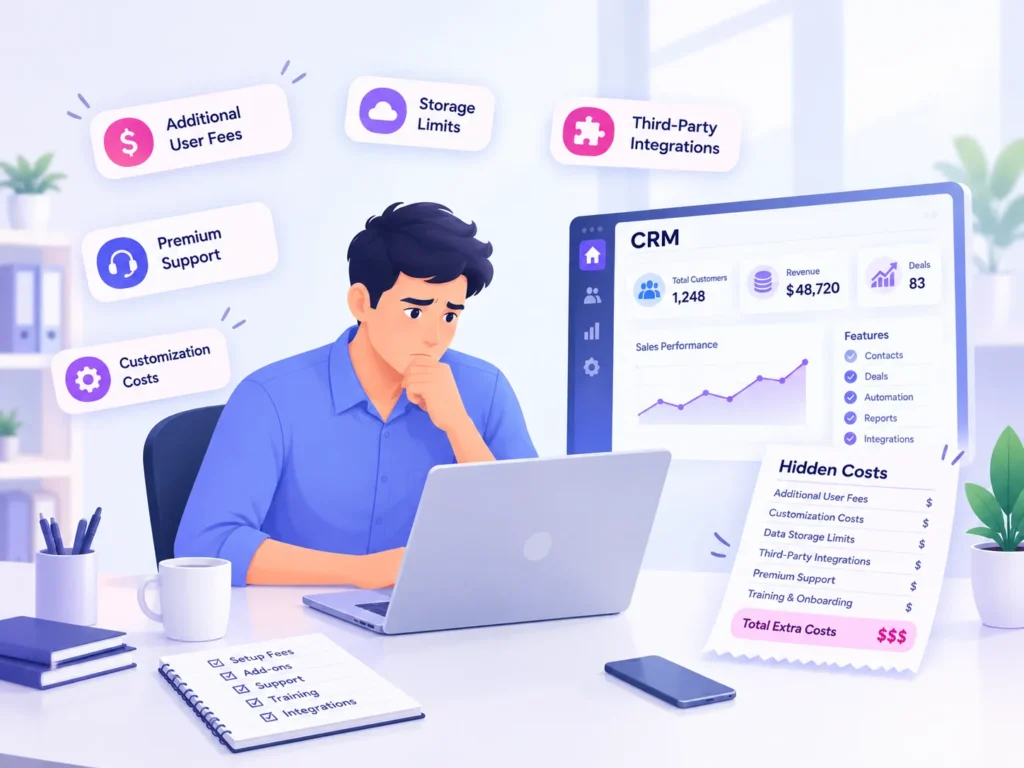
| Hidden Cost Type | Why It’s Easy To Miss | What To Ask Before Signing Up |
| Add-on Fees | Marketed as “Optional” but often needed | Which features are truly included at my tier? |
| Minimum Seats | Buried in terms, not the pricing page | Is there a minimum seat count regardless of my team size? |
| Migration/onboarding | Only mentioned during sales calls | Is data import free, or a paid service? |
| Overage charges | Only triggered once you exceed a limit | What happens exactly when I hit my contact or storage cap? |
| Integration fees | Assumed to be included, often isn’t | Does API access or this specific integration require a higher tier? |
| Support tier gates | Support quality isn’t visible until you need it | What support level is included in my actual plan? |
| Renewal price increases | Introductory pricing looks permanent | Is this price locked in, or does it increase after year one? |
How Hidden CRM Costs Affect Total Cost of Ownership
CRM total cost of ownership means the full cost of using a CRM over time, not just the monthly subscription fee. A complete total cost of ownership picture includes:
- The base subscription price (per user, per month or year)
- Any CRM add-on fees for features you actually need
- One-time migration or setup costs
- Ongoing overage charges as your contact list or team grows
- Staff time spent on configuration, training, and troubleshooting
A plan that looks like the cheapest option on paper can have a higher total cost of ownership than a slightly more expensive plan that includes more of what you need by default. This is why comparing sticker prices alone often leads to inaccurate budgeting.
CRM Add-On Fees by Category
Not all CRM add-on fees are created equal, some are minor conveniences, others gate features most businesses would consider essential. Breaking them down by category makes it easier to spot which ones matter for your situation.
| Add-on Category | Common Examples | How Essential Is It Typically? |
| Automation | Multi-step workflows, triggered emails | Often genuinely optional for small teams |
| Reporting | Custom dashboards, advanced analytics | Depends heavily on how data-driven your process is |
| Communication | Phone/dialer integration, SMS | Essential only if this is a primary contact channel |
| Data | API access, advanced import/export | Matters more if you rely on multiple connected tools |
| Support | Priority or phone support | Becomes more important as your team and usage grow |
Reviewing this kind of breakdown before comparing providers helps separate CRM add-on fees you can reasonably skip from ones that would functionally cripple the plan without them.

Why CRM Total Cost of Ownership Is the Better Comparison Metric
Comparing CRMs on subscription price alone is a bit like comparing cars on sticker price without factoring in fuel, insurance, or maintenance. CRM total cost of ownership is the more complete metric because it captures everything you’ll actually spend, not just the number on the pricing page.
A useful mental model: treat the advertised price as a starting point, not a conclusion. Build your own total cost of ownership estimate by adding every line item relevant to your business, using the categories and questions in this guide, before deciding which option is genuinely the most affordable for your specific situation.
A Practical Example
Consider a plan advertised at $25 per user per month for a six-person team, an apparent cost of $150 per month. Once you factor in a required marketing automation add-on ($40/month), a one-time data migration fee ($200), and a support tier upgrade needed for phone support ($15/user/month), the real first-year cost looks meaningfully different from the advertised $150 per month starting point.
This doesn’t mean the CRM is a bad choice, only that the full total cost of ownership needs to be calculated before comparing it fairly against alternatives.
Questions to Ask Before You Commit
Asking these questions upfront, ideally in writing, surfaces most hidden CRM costs before they become a surprise on your invoice:
- Which specific features are included at my exact plan tier, not just the tier’s general description?
- Is there a minimum seat requirement, and does it apply to my team size?
- Is data migration free, or is there a setup fee?
- What happens exactly if I exceed my contact or storage limit?
- Does this integration or API access require a higher tier?
- What support level is included, and what does upgrading support cost?
- Is this price locked in, or will it increase at renewal?
How to Spot Hidden CRM Costs Before You Sign Up
- Read the full pricing page, not just the top-line number. Details about add-ons and limits are often further down the page or in a separate FAQ section.
- Ask for a written quote reflecting your specific team size and needs, rather than relying on the general advertised price.
- Search the provider’s support documentation for terms like “overage,” “add-on,” or “minimum,” which often surface exactly these hidden costs.
- Ask existing customers or read independent reviews, since real users often mention costs that don’t appear on the pricing page at all.
- Compare CRM total cost of ownership, not just monthly price, across every option on your shortlist.
Real Scenarios Where Hidden CRM Costs Add Up Fast
Seeing a few realistic scenarios makes hidden CRM costs easier to spot in your own situation.
Scenario 1: The support tier surprise. A small agency signs up for an entry-tier CRM plan and runs into a technical issue during setup. They discover phone support requires an upgrade, and their only option is email support with a multi-day response time during a critical onboarding week. The plan itself wasn’t more expensive than expected, but the lack of accessible support cost them real time.
Scenario 2: The integration gate. An ecommerce store wants to connect its CRM to its existing email marketing platform. The integration exists, but it’s only available on a higher tier, turning what looked like a straightforward setup into an unplanned upgrade decision.
Scenario 3: The migration fee. A growing consultancy assumes importing their existing 800 contacts will be free, since most CRMs support CSV import. It turns out their provider charges for “assisted” migration above a certain contact count, and self-service import doesn’t handle their custom fields cleanly, forcing a choice between paying for help or doing manual cleanup themselves.
None of these are dramatic failures. Each is a small, specific gap between what was assumed and what was actually included, which is exactly the pattern hidden CRM costs tend to follow.

Expert Perspective
In hands-on testing and review of CRM pricing structures at Codixology, a consistent pattern emerges: hidden CRM costs cluster around three areas, add-ons, seat minimums, and support tier gating. Providers rarely hide these entirely, they’re usually documented somewhere, but they’re structured in a way that requires the buyer to actively look for them rather than having them surfaced upfront.
This aligns with general guidance on SaaS buying from independent sources. Evaluating the true cost of a CRM requires looking beyond the advertised price to what’s actually needed to run the tool effectively for your specific use case.
Who Tends to Get Caught Out by Hidden CRM Costs Most Often
Certain business profiles run into hidden CRM costs more frequently than others, usually because their needs sit right at the edge of what an entry tier covers. Fast-growing teams that outgrow contact or seat limits quickly, businesses relying on a specific integration that turns out to be gated behind a higher tier, and companies with a complex existing dataset that doesn’t migrate cleanly are the three patterns we see most often when reviewing CRM setups.
If your business fits any of these patterns, it’s worth being especially thorough with the checklist and questions in this guide before committing, since the gap between advertised and actual cost tends to be largest exactly where these situations overlap.
Related Reading
Building Your Own Hidden CRM Cost Checklist
The questions and categories in this guide are a strong starting point, but the most reliable way to avoid hidden CRM costs is to build a short checklist specific to your own business before you talk to any sales rep. A simple version looks like this:
- I know exactly how many seats I need, and I’ve confirmed there’s no minimum above that
- I have a written list of must-have features and confirmed which tier includes all of them
- I’ve asked directly whether data migration is free at my expected contact volume
- I know what happens if I exceed my contact or storage limit
- I’ve confirmed which support level is included, not just what’s available at the top tier
- I’ve asked whether my quoted price is locked in, or subject to a renewal increase
Walking through this checklist before signing anything turns hidden CRM costs from a surprise into a known, budgeted line item, which is really the whole goal.
The Bottom Line
Hidden CRM costs aren’t usually a scam, they’re a structural feature of how CRM pricing pages are built, and the burden falls on the buyer to ask the right questions before committing. By checking for add-on fees, seat minimums, migration charges, and renewal pricing upfront, you can get a realistic picture of your CRM’s true total cost of ownership rather than being surprised by the first real invoice.
Want to compare real, transparent CRM pricing before you commit? See our full CRM cost breakdown and best free CRM picks to start with options that won’t blindside your budget once the real invoice arrives.
Frequently Asked Questions
What are the most common hidden CRM costs?
CRM add-on fees for features assumed to be included, minimum seat requirements, data migration charges, and overage fees for exceeding contact or storage limits are among the most frequently reported hidden CRM costs.
How do I calculate a CRM’s real total cost of ownership?
Add the base subscription cost to any required add-ons, one-time setup or migration fees, and likely overage charges, then compare that full number across your shortlisted options rather than comparing advertised starting prices alone.
Are hidden CRM costs a sign of a bad or dishonest provider?
Not necessarily. Most providers disclose these costs somewhere in their documentation or terms; the issue is usually that they’re not surfaced clearly on the main pricing page, requiring buyers to dig for the full picture.
Do free CRMs have hidden costs too?
Free CRMs typically don’t carry hidden monetary fees, since there’s no invoice to inflate, but they may carry hidden costs in the form of limited features that push you toward eventually paying for a feature you assumed was standard.
What’s the single best way to avoid hidden CRM add-on fees?
Get a written quote based on your specific team size, contact volume, and must-have features before signing up, and ask directly whether any of those items require an add-on or higher tier.
Do prices typically increase after the first year?
This varies by provider. Some lock in introductory pricing only for a limited period, after which standard rates apply at renewal. Always ask specifically whether your quoted price is locked in long-term.
Related reads
Best CRM for Small Agencies and Consultancies
Running a small agency means managing client relationships, project handoffs, and new business pipeline all at once, often with a lean team…
Best CRM for Startups That Scales With You
Finding the best CRM for startups means solving a problem most CRM buying guides don’t address directly: you need something affordable and…
Best CRM for Small Business in 2026 (Hands-On Tested)
Finding the best CRM for small business needs shouldn’t require wading through a dozen “top 10” lists that all rank the same…