
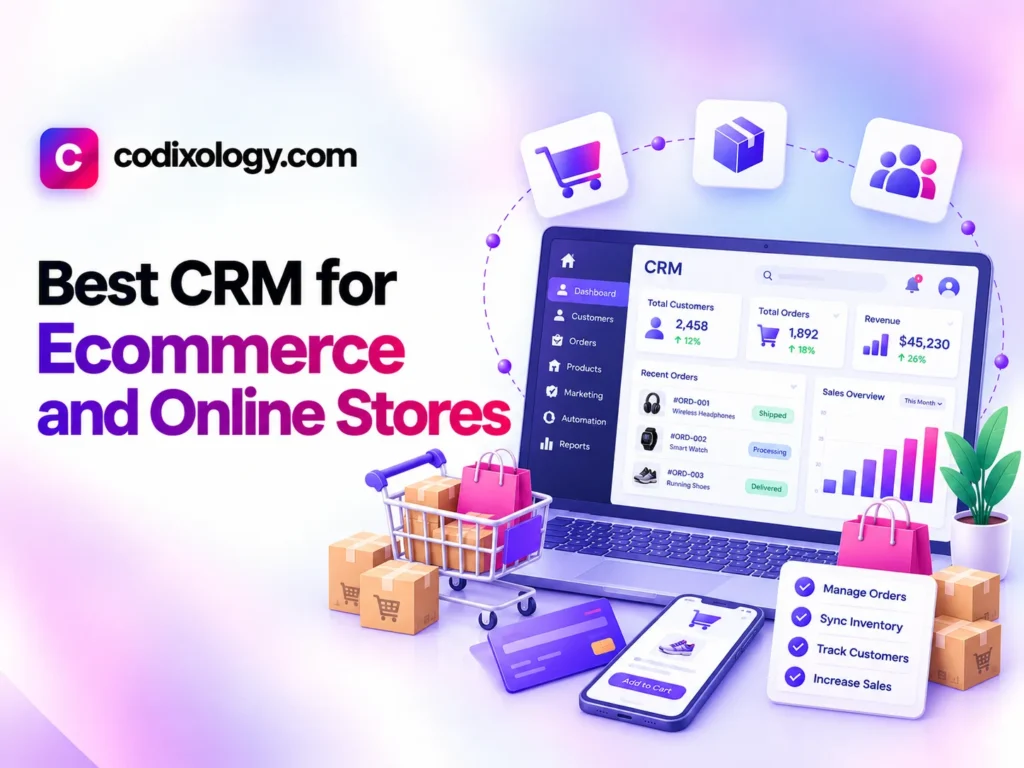
The best CRM for ecommerce is the one that syncs with your store automatically, and for most online stores past about 1,000 customers that means Klaviyo, which segments customers by purchase behavior and runs email and SMS campaigns off the same data. Smaller stores can get by on Shopify’s built-in customer segments or HubSpot CRM’s free tier, stores that also sell wholesale or B2B are better served by Zoho CRM, and ActiveCampaign suits stores that want detailed behavior-triggered automation. A CRM that only tracks generic contact records without order data becomes a second system nobody keeps updated, so store integration is the first filter here.
What ecommerce businesses need from a CRM
An ecommerce CRM has to work with transactional data at scale: orders, purchase history and customer segments, often for thousands of customers rather than dozens. That changes the priorities:
- Native store integration. A Shopify CRM (or one built for another platform) needs to sync orders and customer data automatically rather than through manual imports.
- Segmentation by purchase behavior. Grouping customers by what they bought, how often and how recently matters more than generic lead stages.
- Ties to email and marketing automation. Ecommerce leans heavily on repeat-purchase campaigns, so CRM and marketing tools need to work together closely.
- Scale without manual maintenance. Growing customer volume cannot mean constant cleanup.
- Customer service context. Support staff work faster when they can see order history next to the contact record.
Best CRM for ecommerce: quick comparison
| CRM | Known for | Good fit for | Free tier available |
| HubSpot CRM | Free tier, marketing tools on the same platform | Stores wanting CRM and marketing automation together | Yes |
| Klaviyo | Deep ecommerce and Shopify CRM integration | Stores prioritizing email/SMS marketing tied to purchase data | Free trial |
| Shopify Customer Accounts + Segments | Native Shopify functionality | Smaller stores not ready for a separate CRM tool | Yes (built-in) |
| Zoho CRM | Affordable, broad ecommerce integrations | Growing stores wanting CRM plus sales pipeline features | Yes (limited) |
| ActiveCampaign | Strong automation combined with CRM features | Stores wanting detailed behavioral automation | Free trial |
A closer look at the five options
HubSpot CRM
HubSpot’s free tier pairs contact and deal tracking with marketing tools on the same platform, which suits stores that want CRM and email marketing to work together without separate systems.
Best for stores that want a free CRM that can grow into broader marketing automation on one platform.
Klaviyo
Klaviyo is built around ecommerce data. It syncs deeply with Shopify and other platforms, segments customers by purchase behavior and triggers automated campaigns from those segments. As a combined Shopify CRM and marketing tool, it is about as purpose-built as online stores get.
Best for stores whose growth depends heavily on email and SMS campaigns tied to purchase behavior.
Shopify Customer Accounts + Segments
For smaller stores, Shopify’s native customer segmentation may cover basic needs without adding a separate CRM at all. It keeps things simple, though it lacks the deeper automation and relationship tracking of a dedicated ecommerce CRM.
Best for smaller Shopify stores not yet ready to add and maintain a separate CRM.
Zoho CRM
Zoho has broad ecommerce integrations at an affordable price, and it adds a traditional sales pipeline, which is useful for stores that handle wholesale or B2B orders alongside direct-to-consumer sales.
Best for growing stores that need both ecommerce CRM features and a sales pipeline.
ActiveCampaign
ActiveCampaign combines CRM features with detailed behavioral automation, so a store can trigger actions from specific browsing or purchase behavior. That depth suits more complex customer journeys.
Best for stores that want granular, behavior-triggered automation alongside core CRM features.
Ecommerce CRM vs. traditional sales CRM
The difference usually comes down to whether the tool is built around purchase history or around a single deal record.
| Traditional sales CRM | Ecommerce CRM | |
| Primary data | Deals, contacts, sales stages | Orders, purchase history, customer segments |
| Typical volume | Dozens to hundreds of contacts | Hundreds to thousands of customers |
| Core strength | Pipeline and deal tracking | Purchase-behavior segmentation and repeat-purchase automation |
Stores with a smaller, high-touch customer base (custom or B2B ecommerce, for example) sometimes do fine with a traditional CRM. High-volume direct-to-consumer stores generally need dedicated ecommerce CRM features to keep up. Our CRM comparisons hub covers the wider field.
Best CRM for ecommerce by store size
Order volume and customer count usually decide the pick more than platform preference does. Treat it as a starting filter; a complex catalog can justify automation sooner.
| Store size | Typical priority | Common pick |
| Under 1,000 customers | Simplicity, low cost | Shopify native tools, HubSpot CRM |
| 1,000-10,000 customers | Purchase-behavior segmentation | Klaviyo, ActiveCampaign |
| 10,000+ customers | Automation scale, advanced workflows | Klaviyo, Zoho CRM |
| B2B/wholesale hybrid | Pipeline plus purchase history | Zoho CRM |
A hypothetical example: two stores, two CRM paths
Consider two hypothetical stores, a small handmade-goods shop and a mid-sized apparel brand. The handmade-goods shop stayed on Shopify’s native customer segmentation for over a year, since its customer volume was modest and a separate ecommerce CRM would have added cost without a clear return yet.
The apparel brand, growing past several thousand customers, needed a Shopify CRM that could trigger automated win-back campaigns from actual purchase recency. Its previous setup paired Shopify’s built-in customer data with an email tool that did not sync purchase history, so repeat-purchase campaigns ran on guesswork. It chose Klaviyo because its segmentation synced automatically with order data, separating customers who had not bought in 60 days from recent repeat buyers.
Neither store started by asking which platform had the most features. Both started with their actual customer volume and marketing needs, which is usually what separates a CRM that earns its cost from one that adds complexity.
Pricing considerations for ecommerce stores
Ecommerce software budgets are judged against margin per order, so look hard at CRM pricing, especially tools priced by contact volume:
- Contact-based pricing can scale faster than expected. Many ecommerce CRM tools charge by contact or customer count, so model the cost at your projected volume rather than today’s.
- Bundled marketing and CRM tools can reduce total cost. A Shopify CRM like Klaviyo that combines segmentation and email marketing can cost less than separate CRM and marketing platforms, provided you use both functions fully.
- Free tiers suit smaller stores well. Shopify’s native tools or HubSpot’s free plan can cover early-stage needs until volume or complexity justifies an upgrade.
Onboarding an ecommerce CRM without disrupting campaigns
Ongoing campaigns and automations cannot pause while you switch tools, so a phased approach works better than moving everything at once:
- Run the new ecommerce CRM in parallel first. Let it sync store data and build segments for two to four weeks before shutting down the previous system.
- Migrate one campaign type at a time. Moving win-back campaigns first, for example, limits the damage if segmentation does not sync perfectly on day one.
- Verify data accuracy before switching fully. Spot-check that purchase history and customer segments match your store’s actual order data before you rely on the new system for live campaigns.
- Keep historical campaign performance accessible. Knowing what worked in the old system informs your strategy in the new Shopify CRM or ecommerce CRM setup.
Before you decide
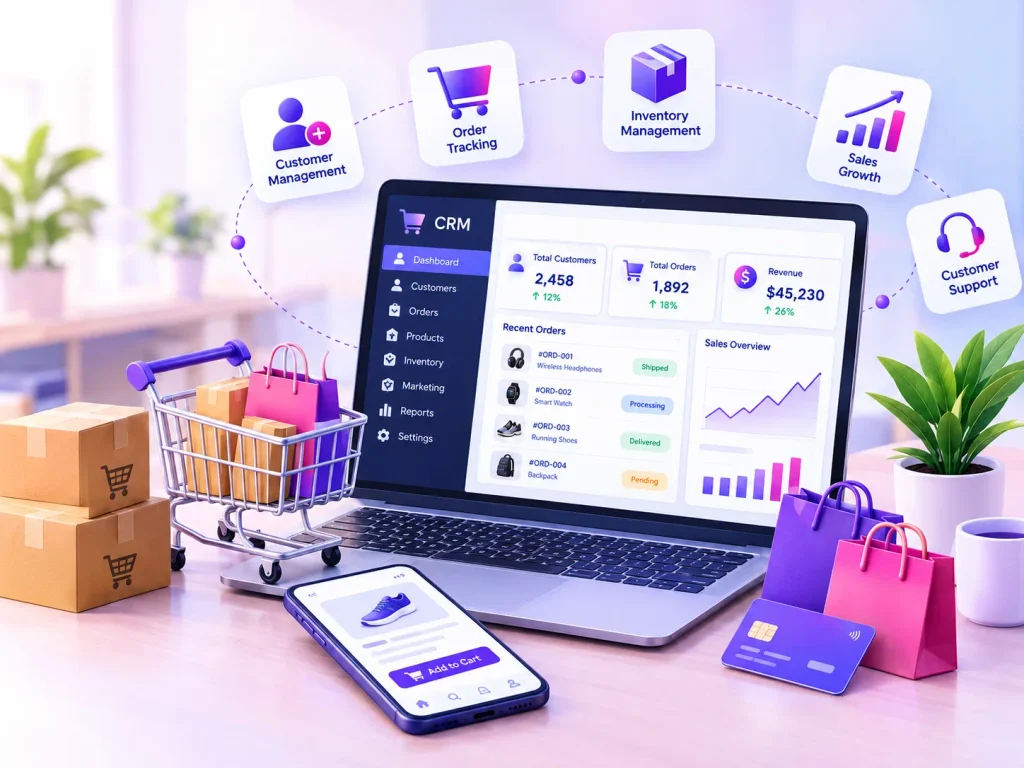
The ecommerce CRM setups that perform best share one trait: purchase and order data flows into the CRM automatically, with no manual entry needed to keep segments accurate. Stores that update customer data by hand see segmentation accuracy degrade as volume grows. The common mistakes follow from this: choosing a CRM that does not sync natively with the store platform, treating CRM and email marketing as separate decisions, ignoring customer service use cases, and settling for basic contact tags instead of real purchase-behavior segmentation. Before committing, ask:
- Does it sync automatically with your store platform, without manual data imports?
- Can you build a basic recency/frequency/spend segment within your first hour of setup?
- Does the pricing model still make sense at double your current customer count?
- Does it connect cleanly with the email or SMS tool you already use, or replace it entirely?
If most answers are yes, you have a real Shopify CRM (or equivalent) rather than a generic tool retrofitted for ecommerce.
Practical tips for ecommerce store owners
- Put native integration ahead of a longer feature list. A Shopify CRM that syncs automatically beats one with more features that needs manual maintenance.
- Start segmentation simple. Recency, frequency and total spend cover most use cases before you add more complex behavioral triggers.
- Trial with real store data rather than a demo dataset.
- Revisit your ecommerce CRM choice as order volume grows. What works at a thousand customers may need more automation at ten thousand.
- Audit your data before migrating. Clean, deduplicated customer records make segmentation far more accurate than importing messy data as is.
- Pair CRM insights with customer service. Support staff who can see purchase history often resolve issues faster.
Related reading
- Free vs paid CRM: which is right for your business?
- Hidden CRM costs nobody warns you about
- Best CRM for small business in 2026: top picks compared
The bottom line
The best CRM for ecommerce is the ecommerce CRM or Shopify CRM that syncs automatically with your store and turns purchase data into usable customer segments, whatever its general feature count. Match a tool to your store’s platform, volume and marketing approach, and see our best email marketing guide and CRM comparisons hub for the tools that pair with it. The goal is the same either way: less manual data work and more accurate targeting of the customers most likely to buy again.
Frequently asked questions
What is the best CRM for ecommerce stores just starting out?
Shopify’s native customer segmentation tools or HubSpot CRM’s free tier are reasonable starting points for smaller stores not yet ready for a dedicated ecommerce CRM.
Is Klaviyo a CRM or just an email marketing tool?
Klaviyo functions as both. As a Shopify CRM, it tracks customer and purchase data while also serving as a full email and SMS marketing platform built around that same data.
Do small stores need a separate ecommerce CRM, or is built-in Shopify data enough?
Smaller stores with straightforward needs often do fine with Shopify’s native tools. Stores running frequent targeted campaigns or managing thousands of customers usually benefit from a dedicated ecommerce CRM.
How does an ecommerce CRM differ from a traditional sales CRM?
An ecommerce CRM centers on purchase history and behavioral segmentation across large customer volumes, while a traditional sales CRM centers on individual deals moving through a pipeline.
Does a Shopify CRM replace the need for a separate email marketing tool?
Not always, though tools like Klaviyo combine both functions. Some stores prefer a dedicated CRM and separate marketing platform, connected through integration, rather than one tool doing both jobs.
What’s the biggest CRM mistake ecommerce businesses make?
Choosing a CRM that doesn’t sync natively with their store platform, which leads to manual data entry that quickly becomes unsustainable as order volume grows.
Does the best CRM for ecommerce change depending on the platform (Shopify vs. others)?
Somewhat. A Shopify CRM built specifically for that platform, like Klaviyo, often integrates more deeply than a general tool, while stores on other platforms should check integration depth carefully before committing.
How often should an ecommerce store revisit its CRM choice?
A reasonable checkpoint is whenever customer volume roughly triples, or when campaign needs outgrow what the current segmentation supports, whichever comes first.
1 comment