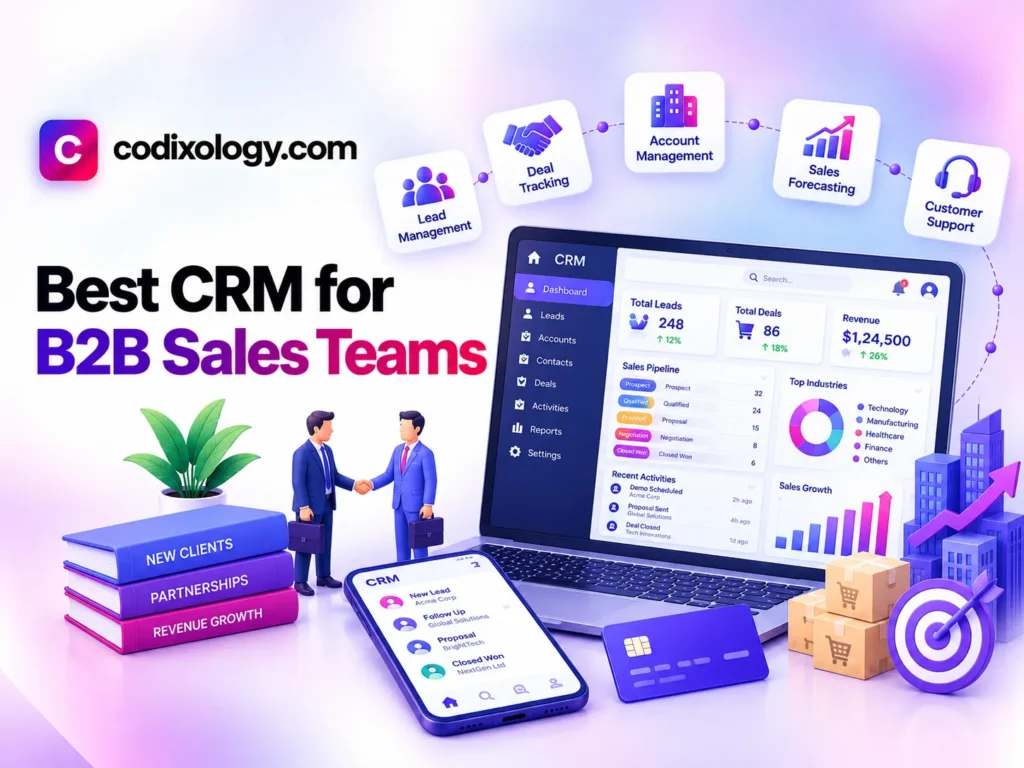
B2B sales cycles are longer, involve more stakeholders, and depend on visibility that a simple contact list can’t provide, which is exactly why finding the best CRM for B2B matters more than it might for a transactional consumer business. This guide compares B2B sales CRM options built around multi-stakeholder deals, longer cycles, and the reporting a sales manager actually needs.
At Codixology, we talk to B2B sales leaders regularly, and the same frustration comes up often: many CRMs are built for high-volume, low-touch sales, not for deals that involve five decision-makers and a three-month evaluation process. This guide is built around that specific gap.
What B2B Sales Teams Actually Need From a CRM
Unlike a consumer-facing business closing quick, single-decision-maker sales, B2B teams need sales pipeline software that reflects a more complex reality. A few requirements stand out:
- Multi-contact account tracking. A single B2B deal often involves several stakeholders, and a CRM needs to track all of them under one account, not as isolated contacts.
- Clear pipeline stages that match a real sales process. Generic stages rarely match how a specific B2B sales cycle actually unfolds.
- Reporting for sales managers. Forecasting, win rates, and deal velocity matter more in B2B, where each deal represents meaningful revenue.
- Integration with email and calendar. B2B sales involves extensive back-and-forth communication that needs to stay visible to the whole team.
- Support for longer sales cycles. A CRM built around quick, one-touch sales can feel awkward for deals that take months to close.
Best CRM for B2B: Quick Comparison
| CRM | Known for | Good fit for | Free tier available |
| HubSpot CRM | Free tier, strong reporting as you scale | B2B teams wanting an all-in-one growth platform | Yes |
| Pipedrive | Visual, pipeline-first design | Teams that want a clear, simple deal-stage view | Free trial |
| Salesforce | Deep customization, enterprise-grade reporting | Larger B2B teams with complex, multi-department needs | No |
| Zoho CRM | Affordable per-seat pricing at scale | Growing B2B teams watching software costs closely | Yes (limited) |
| Close | Built-in calling and email for outbound-heavy teams | B2B teams running high-volume outbound sales | Free trial |
A Closer Look at B2B Sales CRM Options
HubSpot CRM
HubSpot’s free tier covers the fundamentals of B2B sales CRM well: multi-contact accounts, deal stages, and email tracking, all without an upfront cost. As teams grow, the same platform scales into more advanced reporting and marketing tools. See our best CRM for small business comparison for how it stacks up against other general-purpose options.
Best for: B2B teams wanting a free starting point that can grow into more advanced reporting later.
Pipedrive
Pipedrive’s visual, pipeline-first layout is a natural fit for B2B teams who want to see exactly where each deal stands without digging through menus. As sales pipeline software, it keeps the focus on moving deals forward rather than burying reps in unnecessary features. See our full Pipedrive review for a deeper look at its strengths and limitations.
Best for: B2B teams whose main need is a clear, visual view of deal stages and next steps.
Salesforce
Salesforce offers the deepest customization and reporting of any option on this list, which suits larger B2B organizations with complex approval processes or multiple departments needing visibility. The tradeoff is a steeper learning curve and higher cost than simpler alternatives.
Best for: larger B2B teams with complex processes that need extensive customization.
Zoho CRM
Zoho’s per-seat pricing stays reasonable as a B2B team grows, which matters for companies scaling their sales function without a proportional jump in software costs. It’s a solid B2B sales CRM option for teams that need affordability alongside reasonable depth.
Best for: growing B2B teams that want solid functionality without enterprise-level pricing.
Close
Close bundles calling and email directly into the CRM, which suits B2B teams running high-volume outbound prospecting where the sales pipeline software needs to support a large number of calls and emails without switching tools constantly.
Best for: B2B teams running outbound-heavy sales motions who want calling built directly into the CRM.

B2B CRM vs. B2C CRM: Why the Distinction Matters
Not every CRM handles B2B complexity well, and the difference usually comes down to how the tool treats accounts versus individual contacts.
| B2C-oriented CRM | B2B sales CRM | |
| Primary unit | Individual contact | Account, with multiple linked contacts |
| Sales cycle assumption | Short, often single-touch | Longer, multi-touch, multi-stakeholder |
| Reporting focus | Volume and conversion rate | Deal velocity, win rate, forecast accuracy |
A business selling directly to individual consumers rarely needs the account-level structure that B2B sales depend on. If your sales process involves multiple stakeholders per deal, prioritizing tools built with strong account-level views matters more than a flashy feature list. For a broader look at CRM pricing across providers, see our CRM pricing guide.
Best CRM for B2B by Sales Motion
The best CRM for B2B often depends on how your team actually generates and closes deals, not just company size.
| Sales motion | Typical priority | Common pick |
| Inbound, consultative | Account tracking, reporting depth | HubSpot CRM |
| High-volume outbound | Calling and email built in | Close |
| Enterprise, complex approvals | Customization, advanced permissions | Salesforce |
| Lean, budget-conscious team | Affordable per-seat pricing | Zoho CRM, Pipedrive |
This isn’t a strict rulebook, an outbound-heavy team might still prefer HubSpot’s reporting, and an inbound team might want Pipedrive’s simplicity. But it’s a useful starting filter when narrowing a long list of B2B sales CRM options.
Two B2B Teams, Two Different CRM Choices
A ten-person SaaS sales team and a three-person consulting firm illustrate how differently the best CRM for B2B can look depending on sales motion. The SaaS team needed sales pipeline software that supported a structured, multi-stage evaluation process with several stakeholders per deal, and chose HubSpot CRM specifically for its account-level reporting as the team scaled.
The consulting firm, with a much smaller and simpler pipeline, needed something lighter. They picked Pipedrive mainly for its visual clarity, since their B2B sales CRM needs were more about staying organized across a handful of active deals than deep reporting.
Neither team started by asking which CRM had the most enterprise features. Both started by asking what their actual sales motion looked like, which at Codixology is consistently the deciding factor we see separate a CRM that fits from one that gets abandoned within a few months.
Pricing Considerations for B2B Sales Teams
B2B software budgets are typically evaluated against deal value and sales cycle length, so a few pricing factors are worth weighing before committing:
- Per-seat pricing scales with team growth. A B2B sales CRM priced per user can become costly as a sales team expands, model this cost at your projected headcount, not just today’s.
- Free tiers can support smaller B2B teams well. A genuinely usable free plan, like HubSpot’s, can cover a small team’s needs before advanced reporting becomes necessary.
- Enterprise tools carry enterprise pricing. Salesforce’s depth comes with a cost that rarely makes sense for teams under a certain size or deal complexity.
For a full breakdown of how CRM pricing works across providers, see our CRM pricing guide.
A Practical Example
A B2B software company selling to mid-sized enterprises was tracking deals in a spreadsheet, with each stakeholder’s contact information scattered across individual sales reps’ inboxes. When a key champion left their role mid-deal, the sales rep lost weeks trying to reconstruct who else had been involved in the conversation.
The company adopted a B2B sales CRM with account-level tracking, linking every stakeholder to the deal record rather than to an individual rep’s contacts. The next time a champion changed roles, the team could see immediately who else at the account had been part of the conversation, cutting what would have been a multi-week setback down to a single day of re-engagement.
Onboarding a B2B Sales CRM Without Losing Deal Momentum
Switching CRMs mid-pipeline carries real risk for a B2B team, since active deals can’t simply pause while reps adjust to a new system. A phased approach tends to work better than switching everything at once:
- Start with new deals only. Run new opportunities through the new sales pipeline software for a few weeks before migrating deals already in progress.
- Migrate high-value, active deals carefully. These are the accounts where losing stakeholder history would matter most, so prioritize transferring them accurately.
- Keep historical deal data accessible. Past win/loss data helps with forecasting and coaching, don’t let it get lost in the switch.
- Set a single point of contact for questions. A small B2B team rarely needs formal training, but having one person who knows the tool well saves the rest of the team time.
This kind of gradual rollout tends to preserve deal momentum better than an abrupt, all-at-once switch.

Pause and Reflect Before Making Your Choice
Before committing to a B2B sales CRM, run through a short gut-check with your sales team, not just on your own:
- Can you see every stakeholder linked to a deal, not just the person who first replied to an email?
- Does the reporting show what your sales manager actually needs, forecast accuracy, win rate, deal velocity?
- Would your reps actually use this daily, or would they quietly keep working from personal notes and spreadsheets?
- Does the pricing stay reasonable if the sales team doubles next year?
If most answers are yes, you’ve likely found a genuine best CRM for B2B fit rather than a generic tool that happens to technically support sales tracking.
Common Mistakes B2B Teams Make Choosing a CRM
- Choosing a CRM built for high-volume, low-touch sales. A tool optimized for quick consumer transactions often lacks the account-level depth B2B deals require.
- Underestimating reporting needs. B2B sales managers typically need forecasting and win-rate visibility that some simpler CRMs don’t provide well.
- Ignoring how stakeholders are tracked. If a CRM treats every contact as isolated rather than linked to an account, multi-stakeholder deals become hard to manage.
- Skipping input from the sales team during selection. The reps using the best CRM for B2B daily often have different needs than the manager making the final call.
Expert Perspective
In hands-on evaluation of B2B sales CRM adoption, the clearest pattern is that account-level visibility, not just deal-stage tracking, is what separates a CRM that survives a long sales cycle from one that falls apart when a deal gets complicated. Teams that can see every stakeholder tied to an account tend to handle personnel changes and multi-threaded conversations far more smoothly.
This aligns with broader guidance on B2B sales practices. B2B purchase decisions increasingly involve multiple stakeholders, reinforcing why sales pipeline software built around accounts, not just individual contacts, tends to serve B2B teams better long-term.
Practical Tips for B2B Sales Teams
- Map your actual sales stages before evaluating tools, rather than accepting a CRM’s default pipeline structure as-is.
- Involve at least one sales rep in the trial, not just sales leadership, since they’ll be the primary daily user.
- Test account-level tracking with a real, multi-stakeholder deal, not a simple demo scenario.
- Revisit your CRM choice as deal complexity grows, since a tool that worked for simpler sales may strain under more complex, longer cycles.
- Keep a simple weekly pipeline review habit. Scanning stalled deals once a week, rather than relying purely on automated alerts, catches issues a system might miss.
- Document your win/loss reasons consistently. This data becomes far more valuable for forecasting once you have a few quarters of it logged.
Related Reading
- Best CRM for small agencies & consultancies
- Best CRM for Startups That Scales With You
- What does a CRM cost in 2026
The Bottom Line
The best CRM for B2B isn’t the tool with the most features, it’s the B2B sales CRM that reflects how your actual sales process works: multiple stakeholders, longer cycles, and the reporting your team needs to forecast accurately. Use the comparisons in this guide to find sales pipeline software that fits your deal complexity and team size.
Ready to compare more CRM options in detail? See our Pipedrive review and our best CRM for small business picks to round out your shortlist.
Frequently Asked Questions
What is the best CRM for B2B sales teams just getting started?
HubSpot CRM’s free tier is a reasonable starting point for smaller B2B teams, since it covers account-level tracking and basic reporting without upfront cost.
Is Pipedrive good for B2B sales, or is it better suited for simpler sales?
Pipedrive works well for B2B teams that want a clear, visual pipeline, though teams with highly complex, multi-department approval processes may eventually need Salesforce’s deeper customization.
How is a B2B sales CRM different from a general small business CRM?
A B2B sales CRM typically emphasizes account-level tracking across multiple stakeholders and longer sales cycles, while a general small business CRM may focus more on simpler, single-contact deals.
Does sales pipeline software need to include reporting for a small B2B team?
Reporting becomes more valuable as a team grows, but even a small B2B team benefits from basic visibility into deal stages and forecasted revenue.
Can a B2B team start with a free CRM and upgrade later?
Yes, this is a common path. Many B2B teams start on a free tier and move to a paid plan once specific needs, like advanced reporting or more contacts, actually arise.
What’s the biggest CRM mistake B2B sales teams make?
Choosing a tool without strong account-level tracking, which makes managing multi-stakeholder deals and personnel changes significantly harder than it needs to be.
Does the best CRM for B2B change based on sales cycle length?
Somewhat. Teams with very long, multi-stage cycles tend to weigh reporting and account-level visibility more heavily, while teams with shorter cycles sometimes prioritize simplicity and speed over deep customization.
How long does it typically take a B2B team to fully adopt a new CRM?
Most teams see reasonable adoption within four to six weeks of consistent use, though full comfort with reporting features can take a bit longer as reps build the habit of logging detail consistently.
Related reads
Best Free CRM Software in 2026 (Actually Free)
Searching for the best free CRM usually turns up a mix of genuinely free tools and “free trials” dressed up as free…
Best CRM for Nonprofits on a Budget
Finding the best CRM for nonprofits usually means solving two problems at once: tracking donors and supporters the way a sales team…
Best CRM for Ecommerce and Online Stores
Ecommerce runs on order history, repeat purchases, and customer segments, which means the best CRM for ecommerce needs to connect directly to…