The CRM vs spreadsheet question comes up at almost the exact same moment for most growing businesses: a lead gets missed, a follow-up falls through the cracks, or two team members accidentally email the same prospect. If that sounds familiar, you’re already living the CRM vs spreadsheet debate in real time, and this guide will help you figure out exactly when it’s time to switch.
At Codixology, we hear a version of this question constantly from small business owners: “our spreadsheet still technically works, so why would we pay for a CRM?” It’s a fair question, and the honest answer is that a spreadsheet is a genuinely good tool, right up until it isn’t. This guide breaks down the real differences between a CRM and a spreadsheet, when an excel CRM setup is still fine, and the specific signs that tell you it’s time to stop using spreadsheets for customer management.
CRM vs Spreadsheet: The Core Difference
A spreadsheet is a general-purpose tool for storing structured data in rows and columns. A CRM is a purpose-built system designed specifically to track relationships, follow-ups, and a sales pipeline over time, with automation and shared visibility built in.
In the CRM vs spreadsheet comparison, the spreadsheet wins on simplicity and cost. The CRM wins on everything that happens after you’ve entered the data: reminders, history, team visibility, and reporting. Neither is universally “better.” The right tool depends entirely on where your business is right now.
What an Excel CRM Actually Looks Like
Many small businesses build what’s sometimes called an “excel CRM,” a spreadsheet with columns for contact name, company, deal stage, last contact date, and notes. This is a legitimate, low-cost way to track customer relationships when your list is small and your process is simple.
The problem isn’t that an excel CRM is inherently bad. The problem is that it depends entirely on human discipline to stay accurate, and human discipline breaks down as volume and team size grow.
A Side-by-Side Comparison
| Factor | Spreadsheet (Excel CRM) | Dedicated CRM |
| Cost | Usually free, if you already have the software | Free tiers available; paid plans typically per user |
| Setup Time | Minutes | Minutes to a few hours |
| Automated Follow-up Reminders | No, fully manual | Yes, built in |
| Shared Team Editing | Prone to conflicts, overwritten data, version chaos | Built for simultaneous multi-user access |
| Activity History Per Contact | Manual entry, easy to forget | Often logged automatically |
| Scales past 50-100 contacts | Gets unreliable fast | Built for this |
| Mobile Access | Awkward on most spreadsheet apps | Usually a dedicated mobile experience |
| Reporting | Manual formulas, easy to break | Built-in dashboards |
Why Spreadsheets Work, At First
It’s worth being fair to the humble spreadsheet, since it genuinely earns its place early on. A spreadsheet is:
- Free and familiar. No new software to learn if your team already uses Excel or Google Sheets.
- Flexible. You can structure columns however you want, with no rigid template.
- Fast to set up. You can be tracking leads within minutes.
- Fine for small volume. A handful of contacts, managed by one person, rarely needs more than this.
For a solo founder with a dozen active leads, an excel CRM is a completely reasonable choice. There’s no need to overcomplicate things before the complexity is real.

Where Spreadsheets Start to Break Down
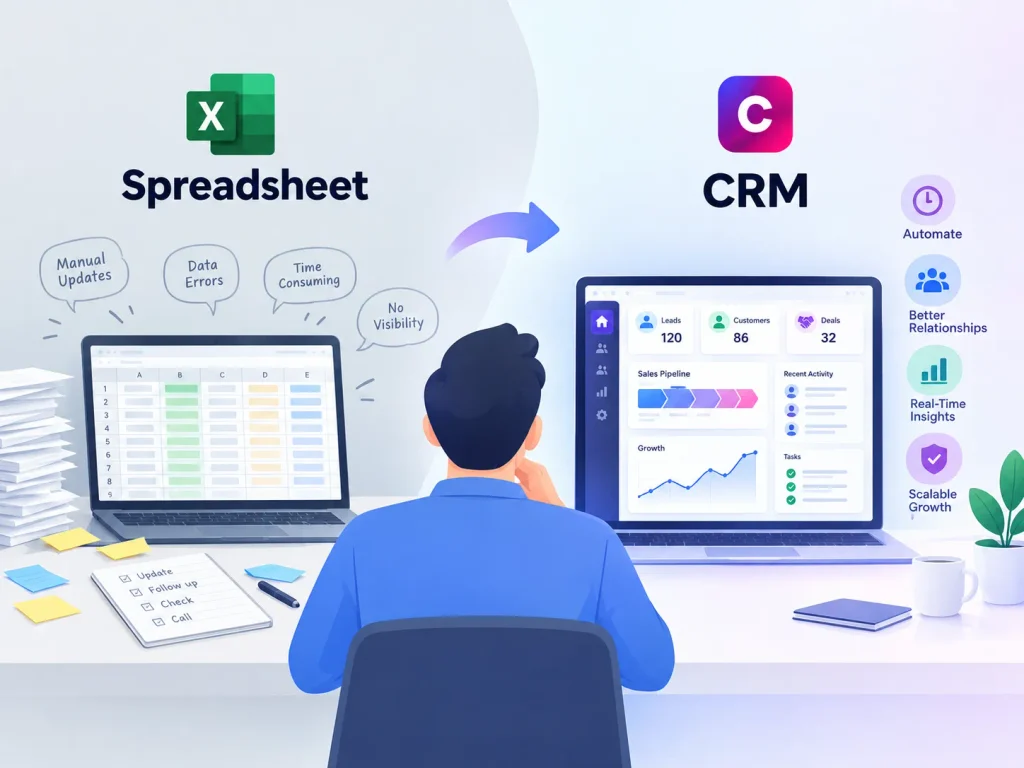
The cracks tend to appear in predictable, specific ways. Recognizing these patterns is the fastest way to know when to stop using spreadsheets for customer relationship management.
1. Duplicate and Conflicting Entries
When more than one person edits the same spreadsheet, duplicate rows and conflicting updates become common, especially if two people are updating the same lead at the same time without realizing it.
2. No Automated Follow-Up Reminders
A spreadsheet doesn’t proactively tell you when to follow up. Any reminder system has to be built and maintained manually, usually with a separate calendar or sticky note, and that extra step is where things get missed.
3. Version Confusion
“Which version is the current one?” becomes a real question once a spreadsheet is emailed around, downloaded, edited offline, and re-uploaded by multiple people. A CRM has one single source of truth by design.
4. Limited Visibility Into the Pipeline
Answering “how many deals are we actively working on right now?” requires manually scanning rows and filtering columns in a spreadsheet. A CRM shows this as a live, visual pipeline.
5. No Real Activity History
A spreadsheet cell might say “follow up sent,” but it won’t show you the actual email, the date, or the full back-and-forth. A CRM keeps that history attached to each contact automatically.
6. It Breaks Down Exactly When You’re Growing
This is the most important pattern: spreadsheets tend to fail right when your business is succeeding, when leads increase, when you hire your first salesperson, or when your process gets more complex. The tool that got you started becomes the thing slowing you down.
Signs It’s Time to Stop Using Spreadsheets
Go through this checklist honestly:
- More than one person now touches the spreadsheet regularly
- You’ve lost track of a lead or forgotten a follow-up at least once
- You can’t quickly answer how many active deals you have
- Duplicate contact rows have started appearing
- Your team spends real time manually formatting or cleaning the sheet
- You’re growing your lead volume and expect that to continue
If three or more of these are true, that’s a strong signal the CRM vs spreadsheet decision has already been made for you, by your own growth.
CRM vs Spreadsheet by Business Size
The right answer to the CRM vs spreadsheet question changes depending on how big your team and contact list actually are. Here’s a general guide by stage:
| Business Stage | Typical Fit |
| Solo founder, under 30 contacts | Excel CRM is usually fine |
| Small team (2-5 people), 30-150 contacts | CRM vs spreadsheet decision point; watch for the warning signs above |
| Growing team (5+ people), 150+ contacts | Dedicated CRM strongly recommended |
| Multiple lead sources or channels | Dedicated CRM recommended regardless of size |
This isn’t a rigid rule, some very small teams with a complex, multi-step sales process need a CRM earlier, and some larger, simple operations get by longer on a spreadsheet. Use it as a general compass rather than a strict cutoff.
Common CRM vs Spreadsheet Myths
A few misconceptions come up often enough in the CRM vs spreadsheet conversation that they’re worth addressing directly.
Myth: “A CRM is only worth it once we’re a real company.” In reality, plenty of solo founders and two-person teams benefit from a simple CRM the moment their sales process gets a second step. Size isn’t the deciding factor, coordination complexity is.
Myth: “Our excel CRM has never lost data, so it’s fine.” Not losing data outright is different from not losing time, follow-ups, or leads. Many spreadsheet problems are invisible until a specific incident makes them obvious.
Myth: “Switching from a spreadsheet to a CRM is a huge project.” For most small businesses, migrating a spreadsheet of a few hundred contacts into a CRM takes an afternoon, not weeks, especially with clean starting data.
Myth: “A CRM is basically just a fancier spreadsheet.” A CRM does store data in structured records, similar to a spreadsheet’s rows and columns, but the automation, reminders, and shared real-time access are the real difference, not the storage format itself.
A Practical Example
Consider a two-person consulting business that starts with a simple spreadsheet: name, company, status, next step. For the first year, it works well. They know every client personally and rarely lose track of anything.
Eighteen months in, they hire a part-time assistant to handle outreach. Within a few weeks, two leads got double-contacted because the assistant and founder were both working from slightly different, unsynced copies of the file. That single incident, avoidable with real-time shared access and automatic logging, becomes the moment they decide to switch to a dedicated CRM.
This is a common story. The switch rarely happens because a spreadsheet “stopped working” all at once. It happens because a specific, costly mistake makes the hidden risk visible.
Making the Switch: What to Expect
Moving from a spreadsheet to a CRM is more approachable than most people expect. Here’s the general process:
- Clean up your spreadsheet first. Remove duplicates and outdated entries before importing, since a CRM will faithfully preserve whatever mess you bring into it.
- Choose a CRM that fits your budget and process. Many CRMs are free for small teams to start. See our picks for the best free CRM software.
- Import your contacts. Most CRMs support direct spreadsheet import (CSV or Excel), mapping your existing columns to CRM fields.
- Recreate your pipeline stages. Match the CRM’s pipeline to however your spreadsheet tracked deal status, so the transition feels familiar.
- Set a cutover date. Pick a specific day to stop updating the spreadsheet and only use the CRM, so you don’t end up maintaining both indefinitely.
The Cost Side of CRM vs Spreadsheet
Cost is often the first objection in the CRM vs spreadsheet conversation, so it’s worth addressing directly. A spreadsheet is free if you already have the software. Many dedicated CRMs also offer free tiers for small teams, so the actual cost difference at the point of switching is often smaller than people expect.
The real cost of staying on a spreadsheet isn’t the software, it’s the staff time spent manually formatting, deduplicating, and chasing follow-ups that a CRM would handle automatically. That time has a real cost even without a monthly invoice attached to it. When weighing CRM vs spreadsheet purely on price, it’s worth counting both sides of that ledger, not just the sticker price of the CRM.
When It’s Still Fine to Stay With a Spreadsheet
Not every business needs to rush this decision. Staying with an excel CRM setup is still reasonable when:
- You’re a solo operator with a small, stable number of contacts.
- Your process is simple, with no real multi-stage pipeline.
- Nothing is currently getting lost or duplicated.
- You’re testing a business idea and don’t want to add new tools yet.
There’s no prize for switching early. The right time is when the spreadsheet’s limitations start costing you real time, real leads, or real trust from your team.
Expert Perspective
At Codixology, in hands-on testing across CRM platforms, one pattern shows up consistently: businesses that switch from a spreadsheet to a CRM after a specific, painful incident (a lost deal, a duplicated outreach, a data loss scare) adopt the new system faster and more thoroughly than those who switch “just because.” A concrete reason to change tends to produce stronger buy-in than a vague sense that it’s probably time.
This aligns with general guidance on CRM adoption from independent sources. The core limitation of spreadsheets isn’t storage capacity, it’s the lack of automation and shared visibility that a dedicated CRM provides by default.
Related Reading
- Do I need a CRM? An honest answer for small teams
- Free vs Paid CRM: Which Is Right for Your Business?
- What is a CRM? A simple guide
A Quick Gut-Check Before You Decide
If you’re still weighing CRM vs spreadsheet after reading this far, try one final gut-check: picture your busiest week in the last three months. Ask whether a follow-up got delayed, a lead got double-contacted, or you genuinely couldn’t say how many deals were active without opening the file and scrolling. If any of that rings true, it’s a reasonably reliable sign that it’s time to stop using spreadsheets as your primary system, even if everything has technically “worked” so far.
The Bottom Line
The CRM vs spreadsheet decision isn’t about which tool is objectively better, it’s about matching the tool to your current stage. A spreadsheet is a fine starting point for a small, simple operation. Once you’re seeing duplicate entries, missed follow-ups, or team visibility problems, those are the concrete signs it’s time to stop using spreadsheets and move to a dedicated system.
Ready to make the switch? Compare our hands-on tested picks in best free CRM software and find one that fits your budget before you outgrow your spreadsheet the hard way.
Frequently Asked Questions
Is a spreadsheet a real CRM, or just a workaround?
A spreadsheet can function as a basic CRM for very small, simple operations. It’s a legitimate workaround, not a “fake” solution, but it lacks the automation, shared reliability, and reporting that a dedicated CRM provides as volume grows.
What’s the biggest risk of sticking with a spreadsheet too long?
Lost or duplicated leads from version conflicts and missed manual follow-ups. These issues tend to compound quietly until a specific incident makes the cost visible.
Can I export my spreadsheet data directly into a CRM?
Yes. Most CRMs support CSV or Excel import and let you map your existing columns to their fields, which makes migrating existing data straightforward.
How do I know if my team has outgrown our excel CRM?
Watch for duplicate entries, missed follow-ups, and difficulty answering basic pipeline questions quickly. The checklist in this guide covers the clearest signals.
Will switching to a CRM slow my team down at first?
There’s usually a short adjustment period while your team learns the new interface, but most CRMs are designed to be intuitive, and the checklist-style migration steps above help minimize disruption.
Is it possible to use both a spreadsheet and a CRM at the same time?
Technically yes, but it’s not recommended long-term. Running both usually recreates the version-confusion problem a CRM is meant to solve. It’s best treated as a short transition period, not a permanent setup.
Is an excel CRM ever better than a dedicated CRM?
For a very small, simple operation, an excel CRM can be genuinely more practical, since it requires no new software and no learning curve. Once a team or contact list grows, a dedicated CRM’s automation tends to outweigh that simplicity.
How do I decide between CRM vs spreadsheet if I’m still unsure?
Try the checklist in this guide first. If you’re honestly unsure after that, a low-risk approach is to trial a free CRM alongside your spreadsheet for a few weeks and see whether the automated reminders and shared visibility make a noticeable difference to how your team works.
What’s the single clearest sign the CRM vs spreadsheet decision is overdue?
Losing track of an active deal, forgetting a follow-up you meant to send, or discovering two team members contacted the same lead independently. Any one of these is a concrete, low-ambiguity signal that a spreadsheet’s limitations have become a real cost.
Related reads
Best CRM for Small Agencies and Consultancies
Running a small agency means managing client relationships, project handoffs, and new business pipeline all at once, often with a lean team…
Best CRM for Startups That Scales With You
Finding the best CRM for startups means solving a problem most CRM buying guides don’t address directly: you need something affordable and…
Best CRM for Small Business in 2026 (Hands-On Tested)
Finding the best CRM for small business needs shouldn’t require wading through a dozen “top 10” lists that all rank the same…